Want a cold email system that generates results like these?

Rated 4.9/5 on Trustpilot
Schedule a Call
All Case StudiesLead Gen Jay
Swan Brothers case study
0 Qualified Opportunities

Swan Brothers: 119 Qualified Opportunities from 95,000 Decision Makers Reached

September 4, 2026Corporate MerchCustom ApparelPromotional Products3PL Fulfillment

Campaign Overview

The Swan Brothers, a Pittsfield, Massachusetts based family business specializing in custom apparel decoration, promotional products, and end-to-end fulfillment, partnered with Lead Gen Jay to build an outbound engine targeting the HR, operations, and marketing leaders responsible for branded gear at mid-sized and large organizations.

The company occupies an unusual position in its category. Alongside screen printing, embroidery, digital printing, and laser engraving, it operates full third-party logistics: warehousing, inventory management, fulfillment, and worldwide distribution. It is also one of roughly 80 authorized New Balance wholesale distributors in North America, and it delivers custom orders in under two weeks against an industry standard of four to eight weeks.

The core challenge was visibility. No buyer searches for a single-source apparel and fulfillment partner because most buyers do not know one exists. They tolerate spreadsheets of employee sizes, reimbursement receipts, and six-week lead times. Cold email was the right instrument precisely because it could interrupt that tolerance with something concrete.

Following technical setup in November 2025 and a launch on January 6, 2026, Lead Gen Jay built and operated a segmented program across four sequences. The first pair targeted larger industry-agnostic companies and smaller creative and event-driven businesses. After five months of live data, the program was rebuilt and relaunched on June 11, 2026 as two optimized campaigns: one for United States and Canada storefront prospects, and one purpose-built for the nonprofit, church, and education segment the data had identified as the strongest fit. Both optimized campaigns are still actively sending today.

Key Metrics

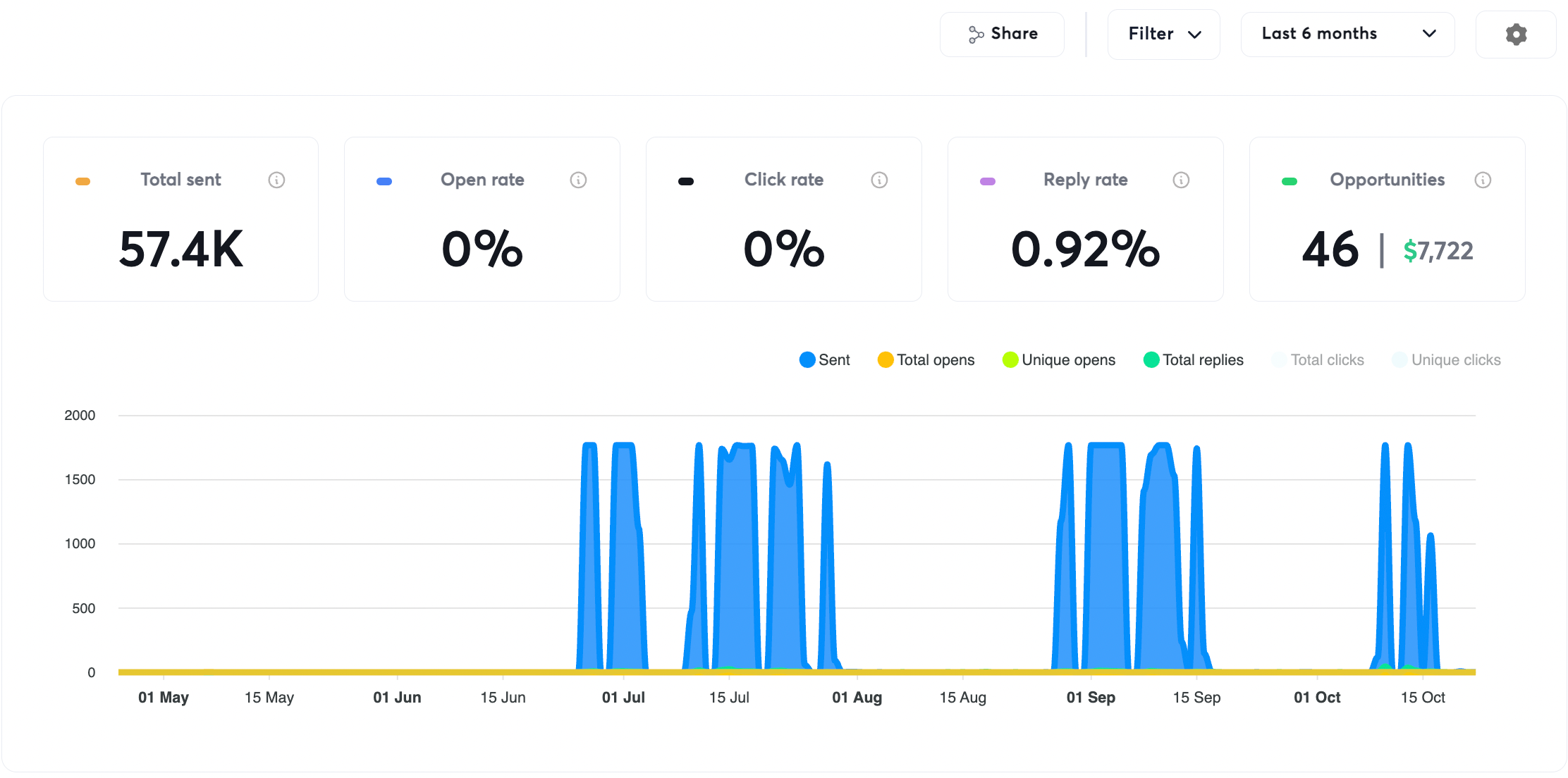
Across four sequences running from January 2026 through early September 2026, the program reached tens of thousands of decision makers and produced a compounding pipeline of qualified conversations.

  • Total Emails Sent: 205,294
  • Total Decision Makers Contacted: 95,440
  • Genuine Human Replies: 622
  • Qualified Opportunities: 119
  • Reply-to-Opportunity Rate: ~19% (close to one in five real conversations turned into a qualified opportunity)
  • Bounce Rate: 1.35%
  • Unsubscribe Rate: ~1 per 808 emails sent
  • Sending Infrastructure: 100 dedicated mailboxes across 31 sending domains
  • Blacklist Incidents: 0 throughout the engagement

Reaching that pipeline required serious infrastructure. The program runs on 100 dedicated sending mailboxes spread across 31 separate sending domains, all warmed and monitored inside Email Bison, with plain-text sending and open and link tracking switched off to protect inbox placement. Mailboxes were later migrated to Google Workspace for stronger deliverability. Deliverability discipline held across the full program, with bounces and unsubscribes both comfortably inside healthy thresholds for cold outbound at this scale.

Best-Performing Campaign

Within the broader program, the Nonprofit Fundraising Store sequence stood out as the strongest performer, producing more qualified opportunities than any other campaign in the account from the smallest contacted audience of the four.

  • Qualified Opportunities Produced: 47 (roughly 40% of the entire program's pipeline)
  • Reply Rate: 7.13%
  • Audience: Nonprofits, churches, private schools, and colleges
  • Comparison to Original Smaller Companies Sequence: More than 7x the reply rate
  • Comparison to Program-Wide Average: More than 3x

The reason this sequence won was a reframe rather than a better subject line. For a corporate buyer, a branded apparel store is a convenience that removes admin work. For a nonprofit or a school, the same store is a revenue line: merchandise sold to parents, alumni, donors, and volunteers, with proceeds coming back to the organization. The sequence led with that dual use, offering a demo store the recipient could either use to outfit staff and volunteers or run as a fundraiser.

Development directors and directors of communications, who are measured on money raised rather than money saved, responded to the fundraising framing at a rate no efficiency pitch had reached. The comparison across the relaunch is the clearest evidence in the account that iteration pays. The two original sequences replied at 1.74 and 1.02 percent. Rebuilding the offer around the segment the data had surfaced lifted the reply rate to 7.13 percent while holding the interested rate near 19 percent — which is what turns a functioning campaign into a compounding one.

Success Factors

Leading With a Built Asset Rather Than an Offer

The most important decision in the program was to stop describing the service and start showing a finished artifact. Every winning sequence opened with a variation of the line: "I built a demo store for your organization, with your colors and logo — mind if I send it?" The prospect is not asked to evaluate a vendor or book a call. They are asked whether they want to look at something that already exists with their brand on it. That converts a cold email from a request into a small gift, and it gave the campaign a low-friction call to action that never needed a meeting ask in the first email.

Killing the Losing Angle Two Weeks In

Two weeks after launch, the data showed the uniform and workwear angle was generating unsubscribes while the store mockup angle was generating replies. The uniform variations were switched off on January 19, 2026 and volume was consolidated behind the store angle alone. Cutting a losing message early — rather than letting it run to preserve a clean test — protected list health and concentrated sending on the variation that was already working.

Treating a New Segment as a Copy Problem, Not a Targeting Problem

The June 2026 relaunch did not re-point existing copy at a new list. The nonprofit campaign was rewritten from the ground up around fundraising, donor gifts, volunteer days, and event gear, with subject lines built for that reader specifically. Both optimized sequences also run spintax across every block and thread their follow-ups under the original email rather than opening new ones. Rewriting for the segment, rather than simply filtering to it, is what produced the account's best campaign.

Infrastructure Scaled in Deliberate Waves

The program runs on 100 mailboxes across 31 domains, built out in two stages. An initial 50 mailboxes carried the launch, and a second 50 were ordered in February 2026, brought through a staged warmup, and joined the campaigns in April. Volume was added only as infrastructure was ready to carry it — which is why the bounce rate held at 1.35 percent while sending scaled past 200,000 emails.

Working the Replies Rather Than Collecting Them

Pipeline was actively converted rather than passively logged. Interested leads were followed up by phone and text the same day, and the reply-handling template was rewritten mid-program to convert more positive replies into booked meetings. In an offer whose entire hook is a visual asset, how fast the store preview reaches a warm prospect materially affects how many conversations advance.

Conclusion

The Swan Brothers program demonstrates that a differentiated but hard-to-explain offer can be sold cold, provided the email leads with proof rather than description. By replacing the pitch with a pre-built branded store, cutting the losing angle within two weeks of launch, and rewriting the sequence from scratch for the segment the data pointed to, the partnership reached 95,440 decision makers and surfaced 119 qualified opportunities from 622 genuine conversations.

Among the 119 qualified opportunities, interest came from decision makers at organizations including Santa Barbara Zoo, Battleship IOWA Museum, Agnes Scott College, Adrian College, Dominican University of California, Pinkerton Academy, Sunnyvale ISD, Divine Savior Holy Angels High School, the Baptist General Convention of Texas, Rock and Brews Restaurants, Dunn Hospitality Group, Aviva Senior Living, Dimmitt Automotive Group, Dupre Logistics, and Expo Convention Contractors — spanning exactly the mix of buyers The Swan Brothers set out to reach.

The clearest signal of the channel's ceiling arrived in the first week. On day two of sending, the Chief Marketing Officer of the Guide Dog Foundation for the Blind replied. A meeting was booked within days, and the organization requested a proposal. Ryan estimated that a single relationship of that type, given the board connections attached to it, could be worth six to seven figures to the business over its lifetime — and it came from an email sent 48 hours after the campaign went live.

The Nonprofit Fundraising Store sequence is now a proven template that can be cloned against fresh contact data as it becomes available, and the two optimized campaigns running today continue to extend the program's results into the next quarter.

Past results do not guarantee future results. Individual outcomes vary based on industry, offer, and implementation.
Want Results Like These?

Book a free strategy call and we'll build a custom plan for your business.

Book Your Free Strategy Call