

Campaign Overview
Cara Conde, a commercial real estate broker with SVN Northern Commercial and principal of Circle 8 Capital Group, partnered with Lead Gen Jay to build a direct-to-owner outbound pipeline focused on sourcing off-market commercial, multi-family, and specialty property deals across the United States, with a heavy concentration in the Midwest.
Cara's business model is straightforward: connect commercial property owners who want to transition out of an asset directly with qualified buyers, investors, and syndicators, fast and off-market, with less commission drag than a traditional public listing.
The challenge was unconventional for cold email. The audience is not a SaaS buyer with a clean CRM record and a verified business email. The targets are commercial property owners, family offices, syndicators, REIT executives, mobile home park operators, and out-of-state landlords. Many own a single asset through an LLC. Many have no public-facing email at all. Almost none of them are waiting for a cold pitch from another broker. Reaching them required a fundamentally different approach to both prospecting and messaging.
The Strategic Pivot: From Generic Operator Lists to Property-Record Intelligence
The campaign initially leaned on conventional commercial real estate prospecting paths, generic operator lists pulled from CRE databases and broad directory-style searches. Early performance fell short of what the audience profile demanded. Operator-level targeting was hitting the wrong owners with the wrong message.
Recognizing this, the Lead Gen Jay team pivoted to a property-record-driven approach: building lead lists directly from PropStream and similar property-data sources, anchored on specific asset characteristics that signal a high probability the owner is open to selling. Instead of guessing which operators might be interested, the team identified owners by the property itself, with address, asset class, and ownership history baked into every outreach.
From that foundation, the campaign was segmented into seven distinct seller personas, each with its own list build, hook, and message angle:
- Multi-Family / Deal Machine: Owners of apartment buildings in syndicator-friendly markets
- Senior Housing: Owners of assisted-living and senior-care properties facing operational fatigue
- Long-Hold Owner: Owners who have held the same asset for five-plus years since the last transaction, a strong tax-event signal
- Buyer-in-Hand / 1031: Address-anchored outreach leading with 'I have a buyer lined up for your property at [address], are you open to selling?'
- Out-of-State Owner Convenience Exit: Absentee landlords managing properties from another state and looking to simplify
- Residential Campaign: Single-family and small multi-family owners in target markets
- Mobile Homes: Mobile home park operators, an underserved persona with high motivation to exit quietly
The address-anchored, 'buyer lined up' framing proved to be the breakthrough angle. By naming the actual property in the opening line, outreach signaled intent and credibility in a way that generic broker pitches never can. Owners who would normally delete a sales email opened the ones that referenced their specific asset.
Key Metrics
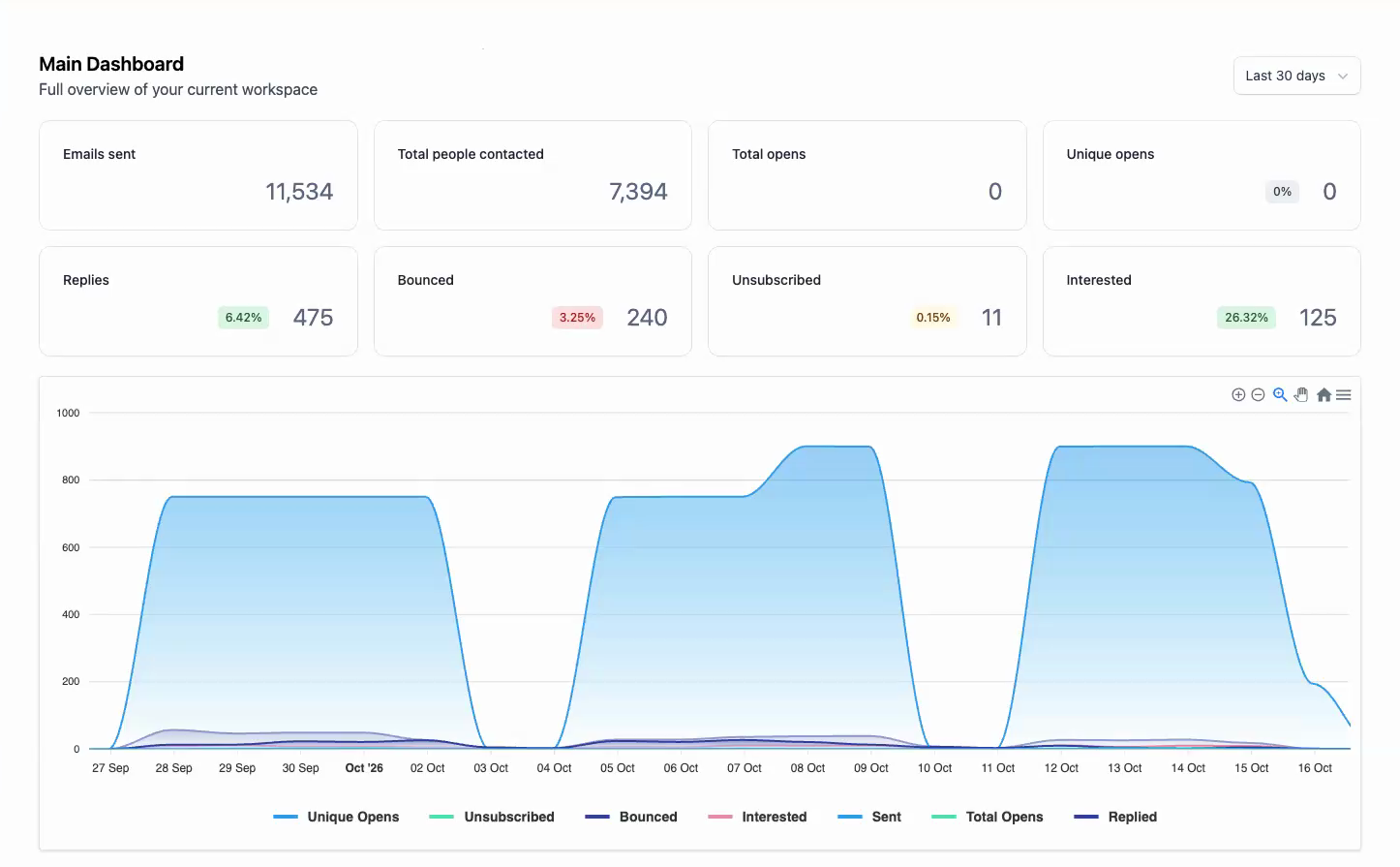
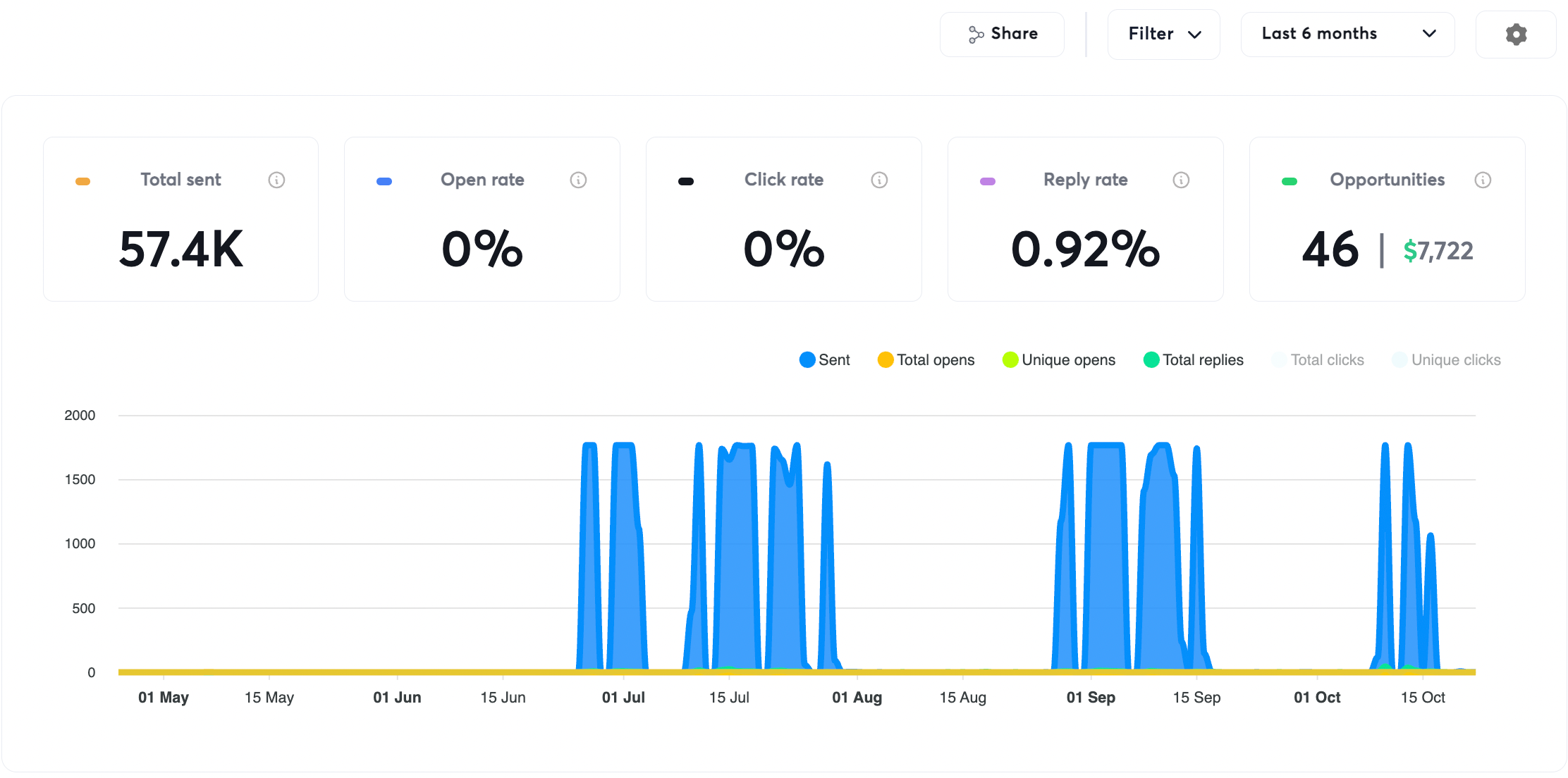
- Total Emails Sent: 26,223
- Total Replies: 227
- Qualified Opportunities (Interested Sellers): 64
- Reply Rate: 0.87%
- Bounce Rate: 0.55% (well below industry baseline)
- Estimated Pipeline Value: $325,000+
The 64 interested responses are the headline number. In commercial real estate, where a single multi-family or senior-housing deal can carry a transaction value north of $2M and a commission well into the five or six figures, a pipeline of 64 motivated-seller conversations represents a material revenue opportunity. Even a conservative conversion rate from that pipeline more than covers the cost of the entire outbound infrastructure several times over.
Best-Performing Campaign
Two top-performing campaigns, Residential 02/16/2026 and Residential 03/12/2026, were scaled up significantly once early positive signal emerged, together accounting for more than 22,000 of the campaign's total sends. These residential-focused sends validated the address-anchored messaging model and provided a scalable template that informed the broader multi-persona strategy.
The Buyer-in-Hand / 1031 angle, which named the specific property address in the opening line, consistently broke through where generic broker outreach typically fails. Property owners immediately understood the sender had done the research, not blasted a database. That credibility signal opened conversations that would otherwise never have started.
Underperforming variants were paused and replaced throughout the engagement. This iterative posture, scale what works and kill what does not, is what moved the campaign to a fully optimized state across all seven personas.
Success Factors
Property-Record-Driven Prospecting
The single biggest driver of campaign success was the shift from generic CRE operator lists to PropStream-sourced, property-anchored lead lists. By building from the property up rather than the operator down, the team reached owners whose specific asset characteristics matched the buyer-side demand Cara could place. This eliminated the spray-and-pray feel of typical broker outreach and replaced it with messaging that felt researched and intentional.
Persona Segmentation
Instead of one master sequence, the campaign ran seven dedicated tracks, each with a distinct hook tuned to a specific seller motivation. Long-hold owners care about tax-deferred exits. Out-of-state owners care about convenience. Senior-housing operators care about operational relief. Mobile home park owners care about discreet, fast transactions. Treating each persona as its own campaign let the messaging earn replies that a one-size-fits-all sequence could not.
Address-Anchored Messaging
The Buyer-in-Hand / 1031 angle, which named the specific property address in the opening line, broke through where generic broker outreach typically fails. Property owners read it and immediately understood the sender had done the work. That credibility signal opened conversations that would otherwise never start.
Disciplined Deliverability Infrastructure
Sending domains were warmed for 30+ days, mailbox count was scaled across the engagement, and tight list hygiene held the bounce rate at 0.55% across all seven campaigns. The infrastructure made the strategy possible. Without it, even the most compelling messaging would land in spam.
Willingness to Iterate
The campaign did not lock in a single playbook on day one. The initial generic-list approach gave way to PropStream-driven targeting. Winning campaigns were scaled aggressively while underperforming variants were paused and replaced. This iterative posture is what drove the engagement to full optimization.
Business Impact
In commercial real estate brokerage, deal value is asymmetric. One transaction can generate more revenue than years of typical B2B contracts combined. With 64 qualified motivated-seller conversations now in pipeline, ranging from single-asset commercial properties to multi-family portfolios, senior-housing operators, and mobile home parks, even a low single-digit conversion rate translates into multiple high-value transactions for Cara's brokerage.
Beyond the immediate pipeline, the campaign validated a repeatable prospecting machine. The PropStream-driven, persona-segmented, address-anchored playbook can be re-run quarterly with refreshed lists, scaled into new geographies, and adapted to new asset classes as Cara's buyer-side demand evolves. The seven personas now serve as standing campaign templates rather than one-off experiments.
The campaign also surfaced valuable market intelligence. Reply patterns by persona, geography, and asset class reveal where seller motivation is concentrated, data that informs not just future cold email but also which buyers Cara should be cultivating on the other side of her marketplace.
Conclusion
Cara Conde's cold email campaign with SVN Northern Commercial demonstrates that even commercial real estate, an audience that has historically resisted cold outreach, can be engaged effectively when prospecting moves from operator-level guesswork to property-level intelligence. Generic CRE lists fell short. A property-data-driven, persona-segmented, address-anchored playbook unlocked a pipeline of 64 motivated-seller conversations from owners who would otherwise have ignored a broker pitch.
With 26,223 emails sent, 227 replies, and 64 qualified opportunities generated, the campaign reached a fully optimized state and delivered an off-market deal pipeline of the kind that traditional broker prospecting cannot reach at scale.
This campaign is a testament to the value of meeting sellers where they actually are. When the generic approach fell short, the willingness to rebuild the prospecting model from the property record up turned a notoriously hard audience into a repeatable source of off-market commercial deals.
Past results do not guarantee future results. Individual outcomes vary based on industry, offer, and implementation.